Jim Atkins' "I'm A Ding Dong Daddy (from Dumas)" is one of my all-time favorite "hot country" songs with its twangy lead guitar, fast pace, and catchy tune. There has never been a comprehensive overview of Atkins' career, so I thought I'd change this. Although Atkins had a long run in the music industry, and with his brother Chet Atkins an even more famous relative, there were likely different men of the same name active in the business and it is sometimes hard to tell them apart. Therefore, as I went deeper and deeper into Atkins' life and career, there appeared mentions of men named Jim Atkins where it is not clear if it's the same man or simply another musician of the same name.
James "Jim" Atkins was born as the oldest son of James Arlie Atkins, a Tennessee native, and grew up in Luttrell, Tennessee. He and his wife had three more children, Nancy Niona (born 1918), Lowell Sylvester (born 1921), and Chester Burton "Chet" (born 1924). It was of course Atkins' younger brother Chet, who rose to fame as a guitarist and later as a producer and music industry giant, being one of the persons making Nashville what it is today. Their parents divorced at some point and married other partners, both giving birth to several half-siblings of Jim and Chet.
While their brother Lowell lived a civilian life, operating his own electric motor repair shop in Kokomo, Indiana, for many years, "Jim was the first to 'make it' in the music business," as Chet later recalled. Jim Atkins got his start as a professional musician in the mid 1930s on Chicago's WLS station and its famed National Barn Dance. Although he started out as a country music performer - old-time or mountain music, as it was then rather called - he was no stranger to other music genres. In 1939, still being based in Chicago, Atkins teamed up with guitar maestro Les Paul and Atkins became part of Paul's jazz trio, playing rhythm guitar on Paul's nationwide network broadcasts. He later also had a radio show with another guitar legend: Leo Fender.
Probably starting in the late 1930s, Atkins was the featured vocalist with Fred Waring's dance orchestra and remained with that group for about ten years. During World War II, the orchestra performed countless war bond rallies and entertained troops across the country. In addition, Atkins was heard on Waring's Chesterfield Time radio show that was broadcast widely through different networks. In the 1940s, Atkins also had his on radio show on WNEW in New York City.
Though, Atkins returned to country music and we find Atkins recording as part of his brother Chet's group in November 1947. Two sessions were recorded for RCA-Victor that month. Atkins would accompany his brother again in September 1951 during a session in New York City. A certain Jimmy Atkins recorded for the independent Continental label in 1949. If this is the same Jim Atkins is unknown to me at the moment.
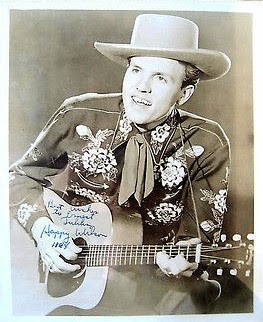
By 1954, Atkins had moved to Birmingham, Alabama, where he worked for radio WBRC, sometimes billing himself as "Uncle" Jim Atkins and accompanied by an all female group known as the "Barnyard Sweethearts". During his time in Birmingham, Atkins wrote several songs and was part of many country music shows, playing alongside such Alabama veteran performers as Jack Turner, Hardrock Gunter, or Happy Wilson.
Previously, Atkins had signed a recording contract with Decca's subsidiary Coral Records and his first disc for the label had appeared in 1950, featuring "T-E-X-A-S" b/w "When Evening Shadows Fall" (Coral #60136). It was not until March 1953 that his next release appeared. It coupled covers of Lattie Moore's "Juke Joint Johnnie" and Jay C. Flippen's "I'm a Ding Dong Daddy (from Dumas)" (Coral #64147). Although this was "hot" music, at least for country music terms, Billboard wasn't too pleased with the performances and they passed without much notice and it became Atkins' last disc for the label.
 |
Billboard C&W review March 7, 1953
|
In October 1954, Billboard reported that Atkins had become associated with Fairway Music Corporation and further, Atkins set up his own record label, Alfa Records. The first and only release comprised Atkins' recording of his own "This Doggone Fiddle" backed by "Two Ton Mama" by Tex Dixon, a singer that appeared on Atkins' radio show during this time. The record apparently sold well enough, at least in the Birmingham area, to prompt Coral to resign Atkins. In February the following year, it was announced that his recording of "That Doggone Fiddle" along with "You Can't Help Being Ugly" was scheduled for release on Coral but in the end, the release was cancelled to unknown reasons. Coral discontinued its country series that same year, which may have been a reason. |
Billboard October 23, 1954
|
Atkins remained with WBRC in Birmingham at least until late 1955. Then, suddenly, Billboard stops to mention his name in its "Folk Talent & Tunes" column. By 1957, we find mention of Atkins working at WARF in Jasper, Alabama (just a little northwest of Birmingham). He had discovered a young singer named Hoyt Johnson, began managing him and connected Johnson with record producer Marshall Ellis in Memphis, Tennessee. Johnson went on to record for Erwin and RCA-Victor but the big success eluded this young singer. Atkins and Johnson even wrote songs together ("It's a Little More Like Heaven (Where You Are)", later recorded by Hank Locklin and, differently, by Johnny Cash as "You're the Nearest Thing to Heaven").
Atkins was probably also involved in bringing Tex Dixon to Marshall Ellis' attention. Dixon, an Alabama native, was part of Atkins' radio show at one time and recorded for several Memphis based labels during the 1950s, 1960s, and 1970s.
There was a Jim Atkins, spinning records for WAPE in Jacksonville, Florida, in 1958, who was possibly the same Jim Atkins that operated Arlingwood Records in Jacksonville. In May 1959, there appeared a Jimmy Atkins on a recording by Barry Etris on the Atlanta based Leo's label plus a certain Jimmy Atkins on the Verve label in 1967. However, I found no evidence that any of these men were the same Jim Atkins.
Atkins recorded again with brother Chet in 1958 and an album was planned to be released the following year on RCA-Victor, which didn't happen though. The recordings saw release in 1963 on a Canadian RCA Camden album entitled "The Guitar Genius", which was reissued by Sundazed eventually. The recordings were also included on Bear Family's large Chet Atkins box set.
What seems to be secure information is that Jim Atkins left the performing side of the music business but remained active with radio work. He surfaced in Denver, Colorado, in the 1960s, where he worked as program director of KOA as early as 1963. He retired in 1968 and not too long afterwards, an interesting record appeared on the Mountain of Colorado label in Denver featuring Big Jim with support by Jimmy Atkins' Hustlers. Coincidence? I'm not sure. The record seems to have been pressed around 1968/1969.
However, following his retirement, Atkins moved to Nashville in 1969 in order to work with his brother Chet again. In the spring of 1971, Jim Atkins was co-founder of FAME, "Famous American Musicians and Educators, Inc.", a company dealing with music education that introduced a special guitar teaching system. While Chet served as a chairman, Jim Atkins was named vice president of the company. The company lasted at least until 1973 and one of the last mentions we find of Jim Atkins is from October 1974, when Billboard reported that Atkins had appeared on the "Sunday Down South" show in Nashville. In March 1975, the Country Music Hall of Fame conducted an interview with Atkins, speaking about his career in music.
Jim Atkins died on January 6, 1977, from a heart attack while visiting his son in Denver. He was 64 years old.
Discography
This discography shows records credited to "Jim Atkins" or "Jimmy Atkins". However, it is not assured that all of them are by the same artist.
Continental C-1253: Scotty MacGregor - It's Santa Claus / Jimmy Atkins - Auld Lang Syne (1949)
Continental C-5115: Jimmy Atkins - An Old Christmas Card / Auld Lang Syne (1949)
Continental 11002: Jimmy Atkins with the Billy Mure Trio - (The Gang That Sang) Heart Of My Heart / On the Old Spanish Trail
Continental 11005: Jimmy Atkins - Engagement Waltz / One Raindrop Doesn't Make a Shower
Rainbow 50022: Jimmy Atkins - You Can't Take It with You / Gone Fishin' (1950)
Coral 60136: Jimmy Atkins with the Mullen Sisters - T-E-X-A-S / When Evening Shadows Fall (1950)
Coral 64147: Jim Atkins and the Pinetoppers - Juke Joint Johnny / I'm a Ding Dong Daddy (from Dumas) (1953) (also released in Canada)
Alfa 102/2: Jim Atkins and Dixie Range Riders - This Doggone Fiddle / Tex Dixon and Dixie Rangers - Two Ton Mama (1954)
Leo's 20011/2: Barry Etris / Jimmy Atkins - guitar, Uncle John Patterson, guitar - I've Met My One and Only / Faded Rose (1959)
Verve VK-10528: Jimmy Atkins with Johnny Smith Quartet - Land of the Velvet Hills / Shenandoah (1967)
Mountain of Colorado 1050: Big Jim with Jimmy Atkins & the Hustlers - Sunset Horizon / One Mistake Too Late (1968/1969)
Recommended reading
Sources
• Adam Komorowski: "From Boppin' Hillbilly to Red Hot Rockabilly" (2006), liner notes, Proper Records
• The Tennessean: "Jim Atkins, 64, Brother of Chet Atkins, Dies" (January 7, 1977)
• Unknown author: "The Guitar Genius" (1963), liner notes, RCA Camden Records


.jpg)


.png)